
Research Portfolio | Economics
Why are some nations wealthy, while others are poor?
A new thesis
In Why Nations Fail, MIT economist Daron Acemoglu and James Robinson, of Harvard, assert that above all else, political institutions—not culture or natural resources—determine the wealth of nations.
In a research profile, Peter Dizikes of MIT News summarizes the thesis as follows: "Countries that have inclusive political governments—those extending political and property rights as broadly as possible, while enforcing laws and providing some public infrastructure—experience the greatest growth over the long run. By contrast, countries with extractive political systems—in which power is wielded by a small elite—either fail to grow broadly or wither away after short bursts of economic expansion."
Learn more in the following reviews, videos, and recorded conversations:
NPR | On Point
Conversation with Daron Acemoglu
"Why do nations rise, and why do they fall? For centuries, explanations have rained down on us. Culture, geography, climate, free markets, military might. A whopping new study says it comes down to this: the wealth of a nation is tied most closely to how much the average person shares in the overall growth of the economy."
The New York Times
Why Some Countries Go Bust
"'When I mentioned that I was interviewing Daron Acemoglu to two econ buffs, they each gasped and said, “I love Daron Acemoglu,” as if I were talking about Keith Richards.' MIT's rock star economist is answering the single most important question in economics: Why are some countries rich while others are poor?"
Video
Daron Acemoglu on Why Nations Fail
"Countries that have 'inclusive' political governments—those extending political and property rights as broadly as possible, while enforcing laws and providing some public infrastructure—experience the greatest growth over the long run. By contrast, Acemoglu and Robinson assert, countries with 'extractive' political systems—in which power is wielded by a small elite—either fail to grow broadly or wither away after short bursts of economic expansion."
MIT News
All the difference in the world
It is among the grandest topics in scholarship: Why do some nations, become wealthy and powerful, while others remain stuck in poverty? In new book, economists Daron Acemoglu and James Robinson assert that above all else, political institutions—not culture or natural resources—determine the wealth of nations.
Charles Mann, author of 1491 and 1493
“Why Nations Fail explains huge swathes of human history. It is equally at home in Asia, Africa and the Americas. It is fair to left and right and every flavor in between. It illuminates the past as it gives us a new way to think about the present. It is that rare book in economics that convinces the reader that the authors want the best for ordinary people. It will provide scholars with years of argument and ordinary readers with years of did-you-know-that dinner conversation. It has some jokes, which are always welcome."
Video
Daron Acemoglu | 26th Annual Henry George Lecture
University of Scranton, Department of Economics and Finance
The Guardian | Observer
Reivew of Why Nations Fail
"Acemoglu and Robinson are intellectual heavyweights of the first rank....Mostly, such people write only for other academics. In this book, they have done you the courtesy of writing a book that while at the intellectual cutting edge is not just readable but engrossing."
New York Times | Reuters
Dignity and the Wealth of Nations
"Why do some countries get rich and others don’t? The authors one-word answer, as Acemoglu summed it up for me, is 'politics.' Acemoglu and Robinson divide the world into countries governed by 'inclusive' institutions and those ruled by 'extractive' ones. Inclusive societies...deliver sustainable growth and technological innovation. Extractive ones can have spurts of prosperity, but because they are ruled by a narrow elite guided by its own self-interest, their economic vigor eventually fades."
Wall Street Journal
The Poverty of Nations
"Why Nations Fail is a splendid piece of scholarship and a showcase of economic rigor."
Econ Talk
Podcast | Acemoglu on Why Nations Fail
Acemoglu draws on an exceptionally rich set of examples over space and time to argue that differences in institutions—political governance and the inclusiveness of the political and economic system—explain the differences in economics success across nations and over time. Acemoglu also discusses how institutions evolve and the critical role institutional change plays in economic success or failure, and the implications of the arguments for foreign aid.
The Economist
Interview with Daron Acemoglu
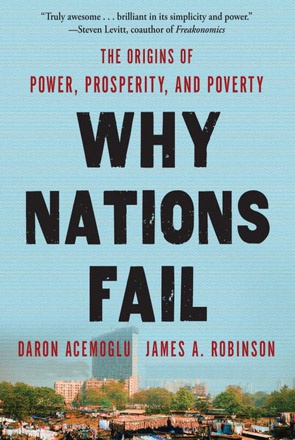
Why Nations Fail
Website

Daron Acemoglu
Acemoglu is the Killian Professor of Applied Economics in the Department of Economics, MIT School of Humanities, Arts, and Social Sciences. In 2005 he received the John Bates Clark Medal awarded to economists under forty judged to have made the most significant contribution to economic thought and knowledge.

James Robinson
Robinson is David Florence Professor of Government at Harvard University. His main research interests are in comparative economic and political development with a focus on the long-run with a particular interest in Latin America and Sub-Saharan Africa.
“Some time ago a little-known Scottish philosopher wrote a book on what makes nations succeed and what makes them fail. The Wealth of Nations is still being read today.
With the same perspicacity and with the same broad historical perspective, Daron Acemoglu and James Robinson have retackled this same question for our own times. Two centuries from now our great-great-great...grandchildren will be, similarly, reading Why Nations Fail.”
— Nobel laureate George Akerlof