
Community Profiles
Janet Sonenberg
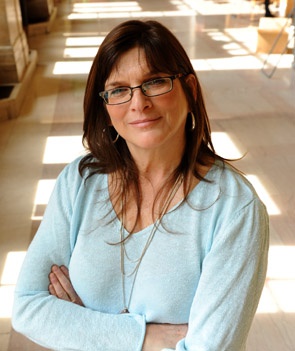
"I'm teaching the smartest kids in the world...young Renaissance masters. I hope every one of them becomes Leonardo!"
Professor of Theater Arts
Former Head, Music & Theater Arts
"There was never a moment that I didn't know I would be in theater," says Professor Janet Sonenberg. "By the time I was five years old and had seen Peter Pan, I was being every character all over the house."
Growing up in New York City, the daughter of arts-loving parents, Sonenberg remembers movies and matinées, bustling restaurants, and the Museum of Natural History. The NYC bookmobile also figured prominently; Sonenberg and her father would enter the mobile library and emerge with books ranging from Eloise to astronomy.
Truth as Magic
Even in this culturally rich childhood, it was what Sonenberg was not supposed to know—including adult commentary on human behavior—that put her on the path to theater. Recalling the times in childhood when she would hear or overhear a more complex human truth, Sonenberg says "I would have goose bumps. I thought the truth was magic. I wanted to spend my life observing truth and replicating it on stage."
Theater in South America, NYC, etc.
She studied theater at Tufts in the 1970s, and in her early twenties was a stage manager and director for American musicals translated and performed across South America. After several years of this apprenticeship, she returned to earn her MFA in Directing from NYU's School of the Arts. In 1979 she began to teach at Hampshire College, where she honed the art and craft of teaching, and in 1992 came to MIT, where she found her professional home.
Here she values the stability of teaching and crafting theater as part of a continuing enterprise, the intellectual environment of a great liberal arts school located within the world's finest technical institution, and the opportunity to work where uncovering truth is valued. And, she quickly discovered that she loves working with MIT students.
"MIT students have free imaginations," she says, "and here I am teaching the whole person, offering them ways of knowing."
Authenticity and Courage
One part of this way of knowing is discovering one's voice, creative take, and interpretation, says Sonenberg. "In art, you can succeed in doing things in an authentic voice at a young age; through theater students can learn what is authentic and why it's rewarding. When you learn to work authentically, you develop the courage to not know, which is what doing science is about."
Behind the Scenes: making the "Tragedy of Thomans Hobbes"
Music and Theater Arts
"From Silence to Science," MIT News