Understanding AI’s Social Impact
AI is transforming society in profound ways. MIT SHASS is at the forefront of exploring the economic, political, and ethical implications of this technology. Our work anticipates the changes ahead, develops the theories and policies needed to make AI a force for good, and prepares MIT students for a fast-changing world.
We work in partnership with the Social and Ethical Responsibilities of Computing (SERC), which is part of the Schwarzman College of Computing.
Initiatives and Programs
Stone Center on Inequality and Shaping the Future of Work
The James M. and Cathleen D. Stone Center on Inequality and Shaping the Future of Work analyzes the forces that contribute to growing income and wealth inequality through the erosion of job quality and labor market opportunities for workers without a college degree. Co-directed by MIT professors Daron Acemoglu, David Autor, and Simon Johnson, the center identifies innovative ways to move the economy onto a more equitable trajectory.
The center’s focus is revitalizing the labor market’s role in generating well-remunerated, high-quality jobs that offer broadly shared prosperity to workers with diverse skills. Achieving those objectives requires shaping the technologies and institutions that determine the value of skills and the distribution of income and wealth, both between labor and capital, and among workers across the occupational spectrum.
Stone Center on Inequality and Shaping the Future of Work
Music Technology and Computation Graduate Program
A new, multidisciplinary MIT graduate program in music technology and computation features faculty, labs, and curricula from across the Institute.
The program is a collaboration between the Music and Theater Arts Section and the School of Engineering. Faculty for the program share appointments between the MTA, the Department of Electrical Engineering and Computer Science (EECS), and the MIT Schwarzman College of Computing.
“Despite their diversity, our students all possess a central commonality,” says program director of professor of the practice Eran Egozy, “not just a shared love for music, but also a deep desire to augment that passion by way of technology in a very warmhearted, humanitarian way.”

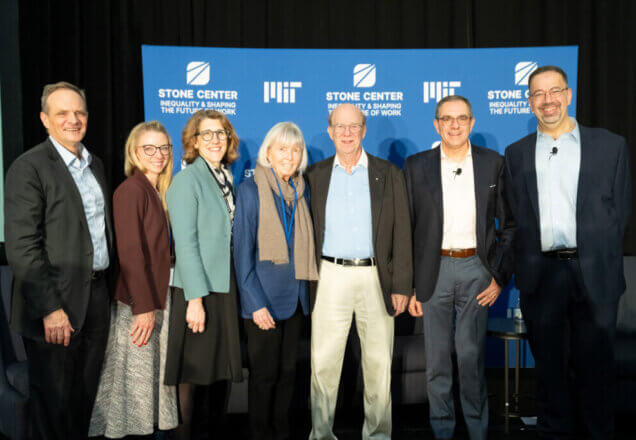
Co-directors of the Stone Center on Inequality and Shaping the Future of Work stand with Stone Foundation leadership at the launch of the new center.

Generative AI for pro-democracy platforms
In this paper, researchers from the MIT GOV/LAB present a framework to help policymakers, technologists, and the public assess potential opportunities and risks when incorporating generative AI into online platforms for discussion and deliberation in order to strengthen democratic practices and help democratic governments make more effective and responsive policy decisions.
This paper is cross-posted from MIT’s Exploration of Generative AI series grouped under the Social Implications of AI.
New J-PAL research and policy initiative to test and scale AI innovations to fight poverty
The Abdul Latif Jameel Poverty Action Lab (J-PAL) is funding new research studies to understand how artificial intelligence innovations can be used in the fight against poverty through its new Project AI Evidence.
The age of AI has brought wide-ranging optimism and skepticism about its effects on society. To realize AI’s full potential, Project AI Evidence (PAIE) will identify which AI solutions work and for whom, and scale only the most effective, inclusive, and responsible solutions — while scaling down those that may potentially cause harm.

At MIT and elsewhere, professor and founding director of MIT GOV/LAB Lily Tsai says, “there’s a growing community of scientists and engineers that are thinking about how to create a new digital civic infrastructure.”
Sparking Dialogue
Exploring the societal impacts of AI
At the recent AI and Society Forum at MIT, experts from across the Institute discussed the potential benefits and dangers of technological innovation on labor, the nature of work, civil discourse, election administration, and other topics.
The event featured individual research presentations and panel discussions, as well as a musical performance exploring the use of generative artificial intelligence in the arts.
The forum was co-organized by the School of Humanities, Arts, and Social Sciences (SHASS) and the Social and Ethical Responsibilities of Computing (SERC). It was presented in collaboration with two of MIT’s strategic initiatives: the MIT Generative AI Impact Consortium (MGAIC) and the MIT Human Insight Collaborative (MITHIC).
AI and Society

The Jobs and AI Panel explored AI and its potential and practical impacts on a variety of job sectors.
Envisioning the Future of Computing Prize
Presented by the Social and Ethical Responsibilities of Computing (SERC), a cross-campus initiative of the MIT Schwarzman College of Computing, in collaboration with SHASS and with support from MAC3 Philanthropies, the competition recently invited MIT students to identify, in 3,000 words or fewer, which sector stands to gain the highest net positive impact from artificial intelligence.
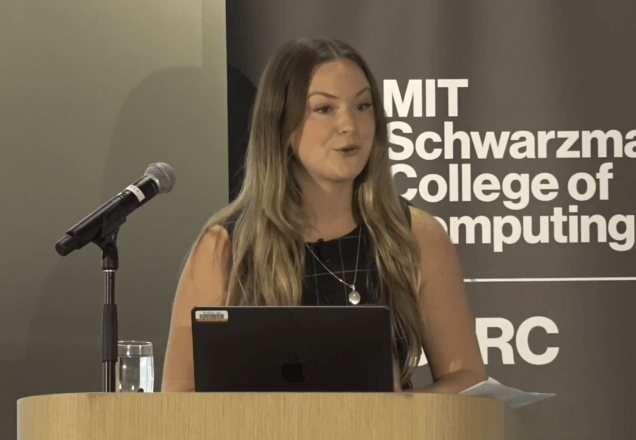
Students were encouraged to explore realistic technological deployments while considering potential risks and ethical concerns. All submissions were eligible for cash awards with the grand prize set at $10,000. PhD student Rachel Sava, the 2026 winner of the Envisioning the Future of Computing Prize, explored transformative improvements and dystopian risks of neural technology.
Envisioning the Future of Computing Prize
What’s the right path for AI?
Who benefits from artificial intelligence? This basic question, which has been especially salient during the AI surge of the last few years, was front and center at a recent conference at MIT, where speakers and audience members grappled with the many dimensions of AI’s impact.
The event was hosted by the MIT Program in Women’s and Gender Studies. Manduhai Buyandelger, the program’s director and a professor of anthropology, provided introductory remarks.
Titled “Gender, Empire, and AI: Symposium and Design Workshop,” the event was held in the conference space at the MIT Schwarzman College of Computing, with over 300 people in attendance for the keynote talks.

Envisioning the Future of Computing Prize 2026: Rachel Sava

Scholars in the News
David Autor named to TIME100 AI list for 2026
MIT economics professor and department head David Autor was named to Time Magazine’s TIME100 AI list for 2026.
“The intervening years have only reinforced the theory of Autor, one of the nation’s most vocal and prominent economists aiming to ascertain AI’s potential impacts on labor,” the piece notes.
“All this talk of everyone being replaced has been debunked,” Autor says. “It hasn’t happened yet. The U.S. labor market is actually in pretty good shape.”
Artificial Intimacy: Who We Become When We Talk To Machines
In her forthcoming book, Professor Sherry Turkle issues an urgent warning about how our ever-increasing reliance on human-like AI chatbots is eroding our capacity for empathy, caring, and the very qualities that make us human.
“Turkle has long been a voice of sanity in a time of exponentially rising technological promises. Now that AI companions and assistants have become ubiquitous, Turkle argues, we human beings are at an increasing risk of losing human relationships, even with ourselves,” writes The Boston Globe.

A new study led by labor economist David Autor of the postwar U.S. shows which kinds of workers historically filled new tech-enabled jobs.

Helping schools navigate the complex world of AI
With the rapid advancement of generative artificial intelligence, teachers and school leaders are looking for answers to complicated questions about successfully integrating technology into lessons, while also ensuring students actually learn what they’re trying to teach.
Justin Reich, an associate professor in MIT’s Comparative Media Studies/Writing program, hopes a new guidebook published by the MIT Teaching Systems Lab can support K-12 educators as they determine what AI policies or guidelines to craft.
“Throughout my career, I’ve tried to be a person who researches education and technology and translates findings for people who work in the field,” says Reich. “When tricky things come along I try to jump in and be helpful.”
Exploring the impact of AI on elections
Large language models, the technology that powers chatbots, are quickly becoming a go-to for voters seeking information about elections, replacing social media and even leapfrogging search engines.
The New York Times features research led by Adam Berinsky and Charles Stewart III in the Department of Political Science and Chara Podimata in the MIT Sloan School of Management that aims to understand how chatbots influence the democratic process.
The project is supported by a SHASS+ Connectivity Fund grant from the MIT Human Insight Collaborative.

Associate Professor Justin Reich’s work shows high-tech tools infuse into education one step at a time, as schools keep adapting and changing.

In the Classroom
The philosophical puzzle of rational artificial intelligence
To what extent can an artificial system be rational?
A new MIT course, 6.S044/24.S00 (AI and Rationality), doesn’t seek to answer this question. Instead, it challenges students to explore this and other philosophical problems through the lens of AI research. For the next generation of scholars, concepts of rationality and agency could prove integral in AI decision-making, especially when influenced by how humans understand their own cognitive limits and their constrained, subjective views of what is or isn’t rational.
New MIT class uses anthropology to improve chatbots
Young adults growing up in the attention economy — preparing for adult life, with social media and chatbots competing for their attention — can easily fall into unhealthy relationships with digital platforms. But what if chatbots weren’t mere distractions from real life? Could they be designed humanely, as moral partners whose digital goal is to be a social guide rather than an addictive escape?
At MIT, a friendship between two professors — one an anthropologist, the other a computer scientist — led to creation of an undergraduate class that set out to find the answer to those questions.

Offered for the first time in fall 2025, AI and Rationality is part of the Common Ground for Computing Education, a cross-cutting initiative of the MIT Schwarzman College of Computing that brings multiple departments together to develop and teach new courses and launch new programs that blend computing with other disciplines.

Bridging philosophy and AI
Ethics of Computing, offered for the first time in Fall 2024, was created through the Common Ground for Computing Education, an initiative of the MIT Schwarzman College of Computing that brings multiple departments together to develop and teach new courses and launch new programs that blend computing with other disciplines.
The course is co-caught by a computer scientist and a philosopher. Senior Caitlin Ogoe, majoring in Course 6-9 (Computation and Cognition), was a student in the inaugural course offering in the fall of 2024.
“Everything I’ve done with technology is from the perspective of people, education, and personal connection,” Ogoe says. “This is a niche that I love. Taking humanities classes around public policy, technology, and culture is one of my big passions, but this is the first course I’ve taken that also involves a philosophy professor.”

Armando Solar-Lezama, the Distinguished Professor of Computing (left), and Brad Skow, the Laurance S. Rockefeller Professor of Philosophy, co-teach 6.C40/24.C40 (Ethics of Computing). The course was offered for the first time in Fall 2024, and was created through the Common Ground for Computing Education, an initiative of the MIT Schwarzman College of Computing.