Aleksandra (Ola) Kaminska
Mechanical Engineering major
Computer Science minor
Spanish minor
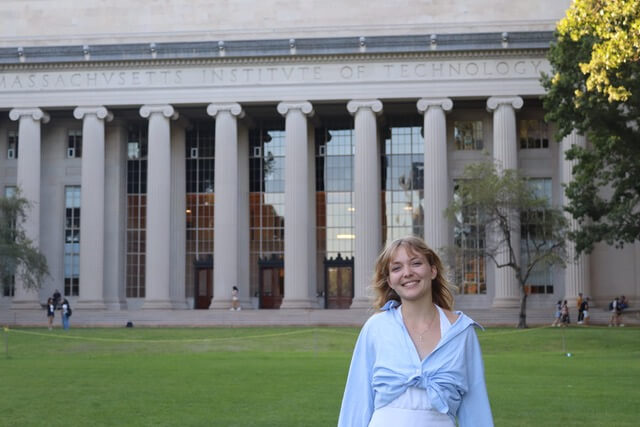
What’ve you enjoyed most about your area of study? Was there a particular discovery, new skill or way of thinking, or insight that you found especially valuable? Please share an example from your favorite class or experience.
What I have enjoyed most about studying Spanish is how every class has managed to surprise me. Spanish is unique in that it connects countries with remarkably diverse yet intertwined histories, and my courses at MIT have consistently pushed me beyond grammar and vocabulary into something much richer. One of my favorite classes was the Latin American Film class I took with Prof. Ana Yanez. It was amazing to peek into a whole different world through the art of film, and a lot of fun to discuss the content with my peers in class!
How does the knowledge from this field, or your interest in it, combine with your other major or minor studies at MIT?
My Spanish minor and my engineering degree at MIT have turned out to be far more intertwined than I ever expected. Engineering gave me technical skills, but Spanish gave me the ability to communicate that knowledge across cultural and linguistic barriers. This past summer, I worked with the MIT Edgerton Center’s Engineering Design Workshop, where knowing Spanish allowed me to lead a workshop for single-mother Spanish-speaking families, where I was translating in real time so that both mothers and children felt included.
This past IAP, I participated in Prof. Margery Resnick’s Spanish Incubator class, where I spearheaded a collaboration between the American International Institute and the Edgerton Center, leading hands-on engineering exploration classes for local students and turning engineering outreach into a cross-cultural exchange. I believe that innovation cannot happen without collaboration and cross-cultural exchange, and I plan to continue bridging these gaps for innovation in the future.
An MIT education includes study in the scientific, technical, social science, arts, and humanities fields. How do you think that wide range of knowledge and perspectives will be valuable to you – for your career success and for your enjoyment of life?
MIT taught me that the most interesting problems live at the intersection of fields. My education has spanned engineering, computer science, music, film, Latin American history, literature. In every single class, I have been exposed to thinking from multiple perspectives simultaneously. This will definitely be valuable in my career, where I know I will be problem solving on the daily. In addition, I plan to continue to bridge engineering and educational pathways for students, and that work demands exactly the kind of interdisciplinary thinking MIT cultivated in me. Nothing will truly prepare you for a question from a curious 12 year old.
What are your plans for the future?
I am currently a Fulbright semifinalist for Argentina, where I hope to spend 2027 as an English Teaching Assistant, continuing the educational and cultural exchange work I began in Boston, Madrid and Barcelona. Otherwise, I am applying for jobs in robotics, where I hope to spend some time in industry learning and applying my technical skills. Down the road, I will go back to graduate school, where I plan to collaborate with many interdisciplinary and globally minded individuals to keep pushing the boundaries of innovation and engineering.