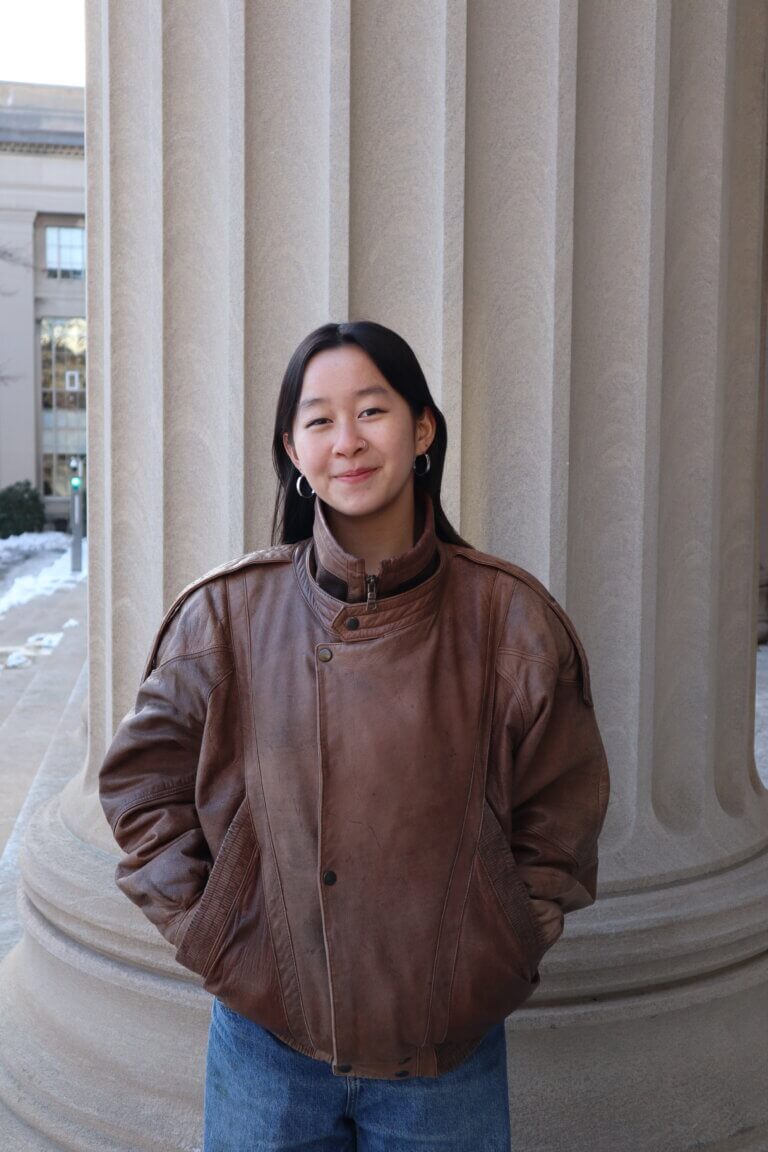
Gloria Zhu
Computer Science and Engineering major
Art & Design major
Comparative Media Studies/Writing minor
What’ve you enjoyed most about your area of study? Was there a particular discovery, new skill or way of thinking, or insight that you found especially valuable? Please share an example from your favorite class or experience.
My favorite part about studying Comparative Media Studies has been learning about and digging into the infrastructures underlying the digital world around us. As our lives are increasingly guided by computational technologies, ranging from social media apps to traffic light scheduling algorithms, I’m both curious and wary about the ways these networks layer upon each other and gently push on the rudder of history. CMS, with its traces of sociology, anthropology, and economics, has helped me position myself in that discourse and think deeply about the impact of my and others’ work on the world. For example, one of my favorite experiences in CMS was in taking CMS.614 (Critical Internet Studies), when we discussed the relationship between labor and invisible work and global platform capitalism.
How does the knowledge from this field, or your interest in it, combine with your other major or minor studies at MIT?
I see Comparative Media Studies as the common thread that runs through my educational experiences in computer science and design. Throughout college, I found a lot of my major-related interests circling back to core ideas in media theory, including the nature and logics of information in computer systems, the way design objects are represented and reproduced in mass culture, and how new forms of digital media like video games and short-form vertical video change the ways we digest and understand the world around us. As my major studies in computer science and design have pushed me to learn technical skills and create new things, CMS has given me the space and language to pull back and analyze those objects through a more critical and socioculturally situated lens.
An MIT education includes study in the scientific, technical, social science, arts, and humanities fields. How do you think that wide range of knowledge and perspectives will be valuable to you – for your career success and for your enjoyment of life?
The breadth of my education at MIT has been essential in guiding my career choices and, more importantly, in making me a more thoughtful and informed citizen. When I entered as a freshman, I expected my education to be focused primarily on technical skills and large-scale engineering projects. Although I have found those components through some of my classes, I’ve also been pleasantly surprised at how much opportunity MIT offers its students to learn about the world broadly and see their work in the real world, rather than just in an enclosed classroom environment.
What are your plans for the future?
In the near term, I’ll be heading to a small design studio, working on data visualization for public good projects. In the long term, I want to conduct design and artistic research, potentially return to grad school, and continue thinking about and making things that reimagine systems in the world around us for the better.