Meicen Sun PhD ’22
Political Science
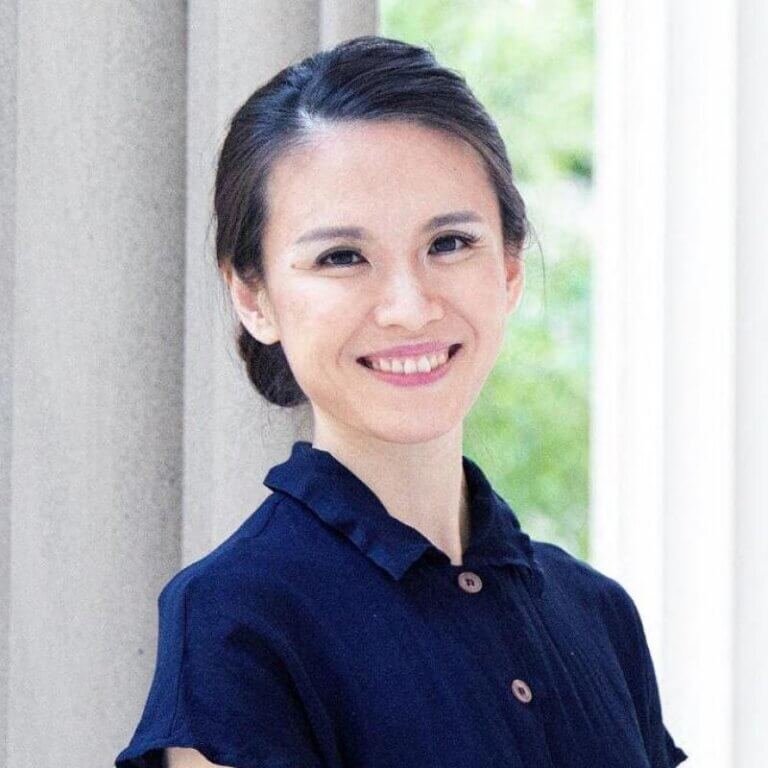
Meicen Sun earned a doctorate in Political Science from MIT in 2022. Sun is an assistant professor at the University of Illinois Urbana-Champaign School of Information Sciences and a faculty affiliate at MIT FutureTech. “My research focuses on how we can approach the social sciences from the perspective of information science,” Sun says, “and blends political economy, information science, and computer science.”
Why did you choose to study your field/ fields at MIT?
I came to MIT looking to study international relations but soon found myself adrift at sea: Tidal waves of information were being digitized and leveraged for economic and political gain, yet few in the field cared to fiddle with what seemed like background noise to real money and hard power.
My Newton’s apple dropped when I got hit with error codes for trying to access foreign web domains from China the summer after my first year: The background noise was not to be assumed away. It was the object. The glitch was, is, and always will be the pathway to power. Now, a dissertation later, I’m glad to have let the apple hit me as hard as it could and run with it as far as I could.
What are you doing now?
I’m an assistant professor at the University of Illinois Urbana-Champaign School of Information Sciences, and an affiliated faculty at MIT FutureTech.
What is the focus of your research or work?
My research focuses on how we can approach the social sciences from the perspective of information science, by redefining the distribution of resources and power as that of information. In practice, my work entails a blend of political economy, information science, and computer science. I look at things both in aggregate and in detail.
On the macro-level, I model social systems as information systems to reveal patterns that defy conventional wisdom. One of my current papers on AI governance highlights how large language models (LLMs) may pose direr challenges to a democracy than to an autocracy. On the micro-level, I run experiments that peek under the hood of LLMs to explain the aggregate patterns we observe, such as sycophancy where models bend over backwards to please the user.
But ultimately, I care about what we, as a society, can do with these findings to translate science into policy. At the Anthropic Economic Futures Symposium in September, I made the case for cultivating an AI-savvy workforce based on my joint work with MIT FutureTech on AI and innovation. At the Second Jimmy Carter Forum on U.S.-China Relations earlier this year, I underscored why winner-take-all is a myth in the so-called global AI race.
How did your experience in SHASS help prepare you for what you want to do in the world?
SHASS provided the crucial resources and flexibility needed for my academic transition that involved a drastic change in coursework and dissertation plans. Such support is instrumental in nurturing a fledgling interdisciplinary research career.
Was there a particular class you took or connection you made in SHASS that had a memorable impact?
Three classes stand out among many:
- Science, Technology, and Public Policy with my adviser Kenneth Oye. It’s substantially informed my thinking about technology policy and my own teaching on the subject now as a faculty.
- Varieties of Capitalism with Kathleen Thelen and Peter Hall. It unpacks how taken-for-granted economic models came into being thanks to both agency and contingency.
- Political Economy with Suzanne Berger and Michael Piore. It’s a tour-de-force synthesis of the field of political economy as we know it.
Besides these, my co-adviser In Song Kim’s research group materially shaped my dissertation development. As my work gets increasingly technical, I keep coming back to what we’d discussed in these “evergreen classes” – from adverse selection to emergence to historical determinism. Meanwhile, what I would have learned from the technical modules I’d skipped can now be done with an AI prompt. SHASS was a good time, and a good idea that has aged splendidly.