Twelve professors selected for 2026-27 cohort of SHASS Faculty Fellows
Selected fellows include professors from Anthropology, History, Linguistics, Literature, Music, Philosophy, Political Science, and Science, Technology, and Society
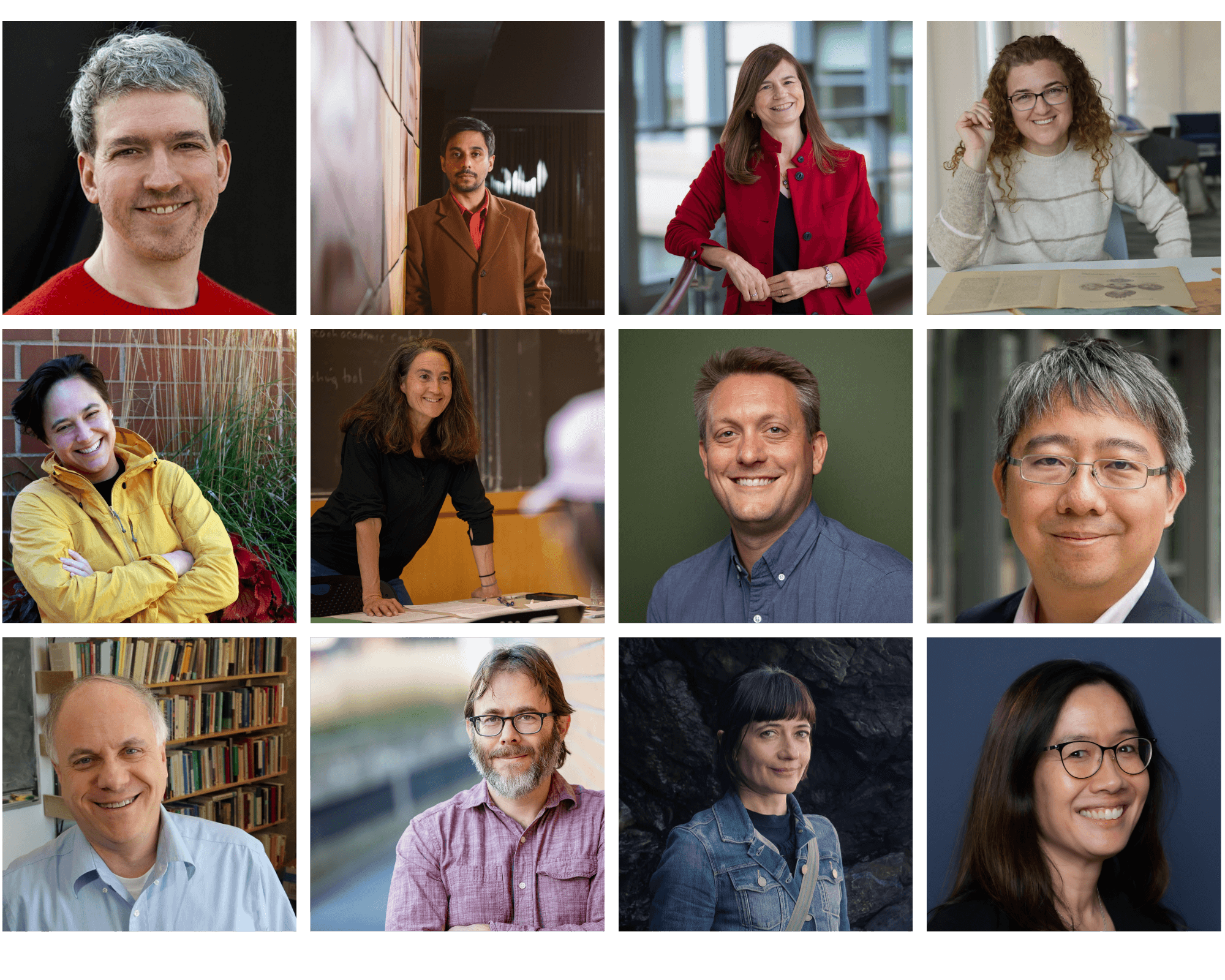
The School of Humanities, Arts, and Social Sciences (SHASS) Faculty Fellows program, administered by the MIT Human Insight Collaborative (MITHIC), is welcoming 12 scholars to its 2026-27 cohort.
The semester-long internal program provides faculty with time to focus on research, writing, or artistic production while receiving collegial support; to foster social and intellectual community within SHASS, including between faculty and students beyond the classroom; and provide informal opportunities to develop intergenerational professional mentorships.
“The projects made possible by the SHASS Faculty Fellows Program can help advance human understanding,” says Agustín Rayo PhD ’01, the Kenan Sahin Dean of SHASS. “Offering opportunities for faculty to carefully investigate big ideas can benefit all of us in important and exciting ways.”
The program was launched in 2025, with an inaugural cohort of fellows for the Spring 2026 semester.
The new fellows include:
Fall 2026
Caley Horan, History
Caley Horan is an Associate Professor of History and historian of the modern United States. Her research focuses broadly on the history of capitalism and the changing meanings of risk and uncertainty in American life. Her first book, “Insurance Era: Risk, Governance, and the Privatization of Security in Postwar America,” won the 2022 Hagley Prize for Best Book in Business History.
During her fellowship, Horan will continue work on a cultural history of uncertainty that traces the expansion of astrological practice and consumption in the US, from the birth of modern astrology in the late nineteenth century to the proliferation of digital astrology apps and media in the twenty-first century.
Jennifer Light, Science, Technology, and Society
Jennifer Light is the Bern Dibner Professor of the History of Science and Technology in the Program in Science, Technology, and Society. Light holds degrees from Harvard and the University of Cambridge, and certifications in personal training and group fitness instruction from the American Council on Exercise. Her research and teaching aim to close the gap between the growing body of research on movement and the learning process and the pedagogical strategies that educators use, finding ways to integrate physical activity and academic instruction at all levels. With colleagues in the MIT Department of Athletics, Physical Education and Recreation she organized the MIT Project on Embodied Education to develop academic/activity collaborations at MIT and beyond. Recent partnerships include the Cambridge STEAM Initiative, the Young Peoples’ Project, and the National Math Foundation.
During her fellowship, Light will investigate what it will take to institutionalize more integrated mind-body education in the 21st century. Her focus is a brief period at the turn of the last century when physical education was the job of classroom teachers who organized relay races in the aisles and vaulting competitions over chairs and desks. Educators found creative ways to pair literature, history, and science with calisthenics, dance, and other forms of exercise—practices they explained with reference to physiology, neurology, and allied sciences that offered evidence about the connections between active bodies and active minds.
Benjamin Mangrum, Literature
Benjamin Mangrum is an Associate Professor of Literature. He’s the author of two books, “The Comedy of Computation: Or, How I Learned to Stop Worrying and Love Obsolescence” (Stanford UP, 2025) and “Land of Tomorrow: Postwar Fiction and the Crisis of American Liberalism” (Oxford UP, 2019). He’s currently writing a book on tragedy. He has also published peer-reviewed scholarship in such journals as PMLA, New Literary History, Diacritics, American Literature, ELH, American Literary History, Modern Fiction Studies, and elsewhere.
During his fellowship, he’ll work on a book on tragedy, “Tragedy in a World of Prose,” the first literary history to chart tragedy’s transformation in the modern era.
David Pesetsky, Linguistics
David Pesetsky PhD ’83 is the Ferrari P. Ward Professor of Modern Languages and Linguistics and MacVicar Faculty Fellow. He received his B.A. from Yale in 1977, and his Ph.D. in linguistics from MIT in 1983. Before joining the MIT faculty in 1988, he taught at the University of Southern California and at the University of Massachusetts at Amherst.
Pesetsky’s research focuses on syntax and its implications for other aspects of human language. Some of his work concerns the structure of Russian and he has done collaborative research on the syntax of music and its relation to the syntax of language. Pesetsky’s publications include the books Zero Syntax (1995) and “Phrasal Movement and its Kin” (2000), and “Russian Case Morphology and the Syntactic Categories” (2014). In 2017, he was the recipient of a festschrift A Pesky Set (an anagram of his name), with contributions from sixty former students. He is currently completing a monograph entitled A Derivational Approach to Clause Size.
During his fellowship, he’ll investigate why there’s more than one kind of clause in the world’s languages. While linguists and researchers assume that clauses in most of the world’s languages come in different flavors, finite and infinitival, gerunds, and so on, they don’t yet know why.
Bradford Skow, Philosophy
Bradford Skow is the Laurance S. Rockefeller Professor of Philosophy. He is the author of “Reasons Why” (2016), “Objective Becoming” (2017), and “Causation, Explanation, and the Metaphysics of Aspect” (2019), all from Oxford University Press. He writes about philosophy and the arts at mostlyaesthetics.com, and, most recently, published a book of poetry, “American Independence in verse,” in the fall of 2025. Skow also co-directs the MIT Civil Discourse Project.
During his fellowship, he’ll work on a new book, “Why It’s OK to Raise a Family.” The book is part of a series, published by Routledge: “Why It’s OK: The Ethics and Aesthetics of How We Live.” The books in the series are meant to engage seriously with ethical questions of broad interest without assuming the reader has any knowledge of philosophy.
Bettina Stoetzer, Anthropology
Bettina Stoetzer is Associate Professor of Anthropology. Her research focuses on the intersections of ecology, globalization, and social justice in Europe and North America. Bettina’s award-winning book, “Ruderal City: Ecologies of Migration, Race, and Urban Nature in Berlin” (Duke University Press, 2022), draws on fieldwork with immigrant and refugee communities, as well as ecologists, nature enthusiasts and other Berlin residents to illustrate how human-environment relations become a key register through which urban citizenship is articulated in Europe.
Stoetzer has also co-edited “Shock and Awe: War on Words” with Bregje van Eekelen, Jennifer Gonzalez, and Anna Tsing (New Pacific Press, 2004). She is currently working on a new project on wildlife mobility, climate change, and environmental action in the U.S. and Europe.
At MIT, she teaches classes on cities, migration, infrastructure, environmental justice, and climate change. She received her MA in sociology, anthropology and media studies from the University of Goettingen and completed her PhD in anthropology at the University of California at Santa Cruz in 2011.
During her fellowship, she’ll continue work on a book, “Unsettling Refuge: Disrupted Mobilities in Multispecies Worlds,” which examines the shifting dynamics of wildlife mobility and their broader implications for environmental action in an era of climate change. She’ll explore how current efforts to recover endangered Southern Resident Killer Whales in the Salish Sea in Washington ask central questions around social justice, Indigenous sovereignty, climate change, and biodiversity.
Spring 2027
Arthur Bahr, Literature
Arthur Bahr is a Professor of Literature who studies medieval literature, and especially enjoys reading old books as if they were poems: that is, for how their constituent parts (texts and pages of a manuscript, like lines and stanzas of a poem) work together to create a whole that is more interesting than any of those parts would be in isolation. More fancily put, he blends formalist and materialist approaches in order to find literary resonance in the physical particularities of medieval manuscripts.
He is the author of “Chasing the Pearl-Manuscript: Speculation, Shapes, Delight” (University of Chicago Press, 2024); “Fragments and Assemblages: Forming Compilations of Medieval London” (University of Chicago Press, 2013); and co-editor of “Medieval English Manuscripts: Form, Aesthetics, and the Literary Text,” a special volume of The Chaucer Review (47.4, April 2013). His essays have appeared in ELH, Studies in the Age of Chaucer, Studies in Philology, and The Chaucer Review, among others.
During his fellowship, Bahr will work on “Sheets of Parchment, Sheets of Ice,” an exploration of figure skating and medieval literary culture as sites of performance, inscription, and erasure. The research – conducted in partnership with colleagues from the Department of Mechanical Engineering and the Institute for Data, Systems, and Society – requires studying medieval mystical and anchoritic literature (i.e., medieval religious writings), whose meditative practices may offer analogies to earlier incarnations of figure skating.
Dwaipayan Banerjee, Science, Technology, and Society
Dwaipayan Banerjee is an Associate Professor in the Program in Science, Technology, and Society. He is the author of “Enduring Cancer: Life, Death, and Diagnosis in Delhi” (Duke University Press), “Hematologies: The political life of blood in India” (Cornell University Press) and “Computing in the Age of Decolonization: India’s Lost Technological Revolution” (Princeton University Press).
During his fellowship, he’ll work on developing a research program to examine how computational research infrastructures materialize epistemological commitments. The project develops and analyzes an end-to-end research system built around different premises. The system maintains direct access to source articles and books, while using LLMs (particularly inference models) only for interpretive work across already-retrieved passages.
Andrea Campbell, Political Science
Andrea Campbell is the Arthur and Ruth Sloan Professor of Political Science. Campbell’s interests include American politics, political behavior, public opinion, and political inequality, particularly their intersection with social welfare policy, health policy, and tax policy. She has written five books, including volumes about Social Security, Medicare, Medicaid, and the American tax system. She was inducted into the American Academy of Arts and Sciences in 2016 and the National Academy of Social Insurance in 2007, and served on the National Academy of Sciences Commission on the Fiscal Future of the United States. Recent awards include the Wildavsky Enduring Contribution Award (2021) for her first book, “How Policies Make Citizens,” and the Excellence in Mentoring Award (2020), both from the American Political Science Association Public Policy section. In 2024 she was awarded MIT’s MacVicar Fellowship for contributions to undergraduate education.
During her fellowship, Campbell will work on a book, “The Coming Return of Senior Insecurity.” The book will examine a broad array of threats to senior citizens’ financial security, tracing the reasons for known shortcomings to several factors including Congress’ failure to bolster Social Security in the face of baby boomer retirement, galloping healthcare costs, and the replacement of traditional defined benefit pensions with defined contribution retirement plans. The project also seeks to identify and explore additional sources of seniors’ increasing precarity.
Lerna Ekmekcioglu, History
Lerna Ekmekcioglu is the McMillan-Stewart Professor of History and the author of “Recovering Armenia” (Stanford, 2016), a study of identity and citizenship after the Armenian Genocide. She also co-authored the forthcoming ‘Feminism in Armenian” (Indiana University Press, 2026), which traces a century of Armenian feminist thought through the lives and writings of twelve public intellectuals across the Ottoman Empire, the Middle East, Soviet Armenia, Europe, and the United States.
During her fellowship, she will begin her new book, “(Mis)Interpreting the New Turkey: Halide Edib in American Academia.” The project investigates how a celebrated Turkish feminist nationalist gained authority in the interwar United States while concealing her role in the Ottoman state’s genocidal policies. By tracking how Edib exploited emerging academic and diplomatic networks to legitimize her narrative, the book shows how American universities helped recast genocide as misunderstanding, shaping early Ottoman Studies and distorting historical truth.
Hiromu Nagahara, History
Hiromu Nagahara is the Mitsui Career Development Professor in Contemporary Technology and Associate Professor of History. An historian of modern Japan, Nagahara is the author of “Tokyo Boogie-Woogie: Japan’s Pop Era and Its Discontents” (Harvard University Press, 2017). Nagahara is also the curator of the MIT Libraries digital exhibit From Samurai into Engineers: Eiichirō Honma and MIT’s First Japanese Students, which marked the 150th anniversary of the graduation of MIT’s first Japanese student, Eiichirō Honma (SB 1874), and highlights the experiences of Honma and other Japanese students at MIT who followed in his footsteps.
During his fellowship, he’ll continue work on “The Emperor’s English: Language and Identity Among the Rulers of Imperial Japan,” which explores the history of anglophones and anglophiles among modern Japanese elites.
Patricia Tang, Music
Patricia Tang is an ethnomusicologist specializing in Senegalese music. She received her PhD in Music from Harvard University in 2001. Since then, Tang has taught at MIT in the Music & Theater Arts Section, where she is currently Associate Professor of Music and Associate Head of the Music program.
Tang’s research interests include Wolof music and culture, African popular musics, life history, fieldwork, and ethnography. She is the author of “Masters of the Sabar: Wolof Griot Percussionists of Senegal“(Temple University Press, 2007).
At MIT, Tang regularly teaches subjects including Introduction to Musics of the World, Musics of Africa, and Popular Musics of the World. She also serves as faculty advisor to Rambax, MIT’s Senegalese Drum Ensemble.
During her fellowship, she’ll continue research on the globalization of Afropop music and African immigrant musicians in the diaspora.
Related
Share a Story
Do you have a story to share about an event, a publication, or someone in the community who deserves a spotlight? Reach out to the SHASS Communications Team with your idea.
Email SHASS Communications