Language acquisition around the world
In “The Acquisition of Relativization,” MIT linguist Suzanne Flynn and other researchers investigate how children from different cultures develop language skills.
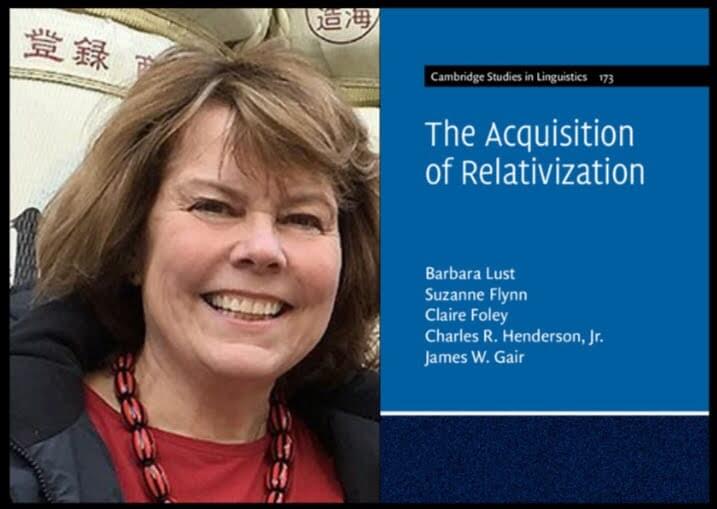
Scholars from a variety of disciplines are investigating language acquisition and how it occurs. Suzanne Flynn, Professor of Linguistics and Philosophy, co-authored “The Acquisition of Relativization,” published in February 2026 by Cambridge University Press. The publication contributes to ongoing debates in linguistics, psychology, and cognitive science by offering ways to resolve them. “This book provides evidence for shared patterns of language acquisition across languages, in spite of their grammatical diversity and cultural variation,” the researchers assert.
In this Q&A, Flynn and her colleagues – Barbara Lust of Cornell University and research affiliate at MIT, Claire Foley of Boston College, Charles R. Henderson, Jr. of Cornell University, and James W. Gair of Cornell University – describe their work’s value, its potential impact, and lessons for non-linguists.
What is the book about?
Our book is a scientific cross linguistic study of how language is acquired by young children across three diverse languages: English (US), French (Belgium), and Tulu (India). This book reflects research that results from over 40 years of continual empirical investigations into the language acquisition process. It also summarizes recent results of multilingual research in adult learners.
The work is interdisciplinary, led by advances in linguistic theory and experimental methods in psychology. It focuses on the acquisition of perhaps the most fundamental property of natural language, i.e., relativization. In doing so, the book offers a paradigm for the study and understanding of the development of language, one in which formal properties provided by language faculty order its development, gradually incorporating language-specific variation across a person’s lifetime.
Why did you and your colleagues decide to write this book?
The book provides new information on the nature of the human competence for language. We realized that, by combining results across comparable experiments, we could pursue the universals we believe underlie language knowledge and its acquisition. Our book provides evidence beyond what a single experiment in a single language can do while also supporting results from each single experiment.
Relativization reflects perhaps the most fundamental property of language. It provides recursion in human language. It thus empowers competency in all languages to create infinite new language expressing infinite new meaning. Proposals in the field today range widely across the entire nature-nurture landscape in attempting to provide explanations for how this computation is acquired. We show how this is a false dichotomy; and we show how a theory of Universal Grammar in fact helps to resolve existing debates.
Active arguments in the field continue to range between proposals for innate programming and proposals for learning through surface strings (by analogy and memory). Our book argues that this is a false dichotomy and provides evidence regarding how both components exist and complement each other in language development.
Some researchers argue that language acquisition is near instantaneous while others believe that learning requires long periods of time. Our results show that “innate programming” is not incompatible with development over time; rather, it directs and constrains it.
Describe the book’s value for audiences.
The book is relevant not only to audiences who are intrigued by the mystery of language acquisition in children and the role of linguistic theory in explaining language acquisition, but also to those intrigued by the mystery of the language faculty in the human mind.
The book also addresses the relationship between language acquisition and language change in general and argues that the results we report contribute to our understanding of the course of language change.
The book is described, in part, as “report[ing] new research on the nature of the human competence for language acquisition.” Does the book have anything to teach us about Large Language Models (LLMs) and their impacts?
Our book reports new basic research. LLMs function on the basis of text they have been previously trained on. Now, AI data centers are continually gaining rights to incorporate new books, such as ours, into their databases.
However, it is not clear how new basic research inputs like our book will be used by future LLMs, or how proper acknowledgement could be assured. Most importantly, it is not clear how the LLMs, even enriched by the text our book provides, can advance the pursuit of the new scientific questions our book engenders.
Fundamentally, work in the field of LLMs has sometimes been argued to support a claim that language can be acquired through probability-based text/string processing. Our research provides evidence that, in contrast, language is acquired through creative hypothesis formation, which is linguistically guided and constrained. Our discovery of linguistically-determined structural constraints on the course of acquisition is inconsistent with string-based models.
Does the book offer ideas and/or lessons for non-linguists?
Our book provides a general understanding of the mind of the child, most specifically with respect to language development in the child. That is, our book provides an understanding that the child’s early seemingly “primitive” forms of language actually reflect development of complex computation. This complexity takes time to develop.
To the degree that we briefly report on results of the acquisition of relativization in adults in multilingual contexts, the book informs audiences, in general, about the continued constraints on the language acquisition process throughout one’s lifetime.
The results provide evidence that child and adult language acquisition are not distinct cognitive processes as is often argued. Adult research results also provide evidence for the manner in which other languages play a role in subsequent acquisition but not in the manner traditionally believed or argued for in various fields. They also support the fact that there is not a so-called “critical period” for theessential process of adult language acquisition.

Share a Story
Do you have a story to share about an event, a publication, or someone in the community who deserves a spotlight? Reach out to the SHASS Communications Team with your idea.
Email SHASS Communications